
India’s EdTech ecosystem has come a long way. There is a growing number of organisations building solutions for education, governments are using technology for multiple purposes, and the evidence on what works is stronger than it was a decade ago.
Yet these parts of the ecosystem are often evolving in parallel, rather than as a connected system. State governments face various challenges that are sometimes immediately apparent and, at other times, latent, but finding solutions that genuinely respond to those needs and have been tested in real-world conditions is not always easy. When 10 vendors present “AI-powered personalised learning solutions”, it can be difficult to know which solution is actually suited to the problem at hand. An EdTech entrepreneur builds something that works in one block of Uttar Pradesh, with no way to know what scaling to 10 districts will entail, or the funding to explore. A researcher’s evidence sits in an academic paper no procurement committee will ever read. Each of these stakeholders is doing their part well. What is missing is something that connects the parts; that takes a need in the education system from a founder’s laptop to a classroom, with enough rigour that a state is willing to bet its budget on it.
That is the gap ShikshaNext was built to close.
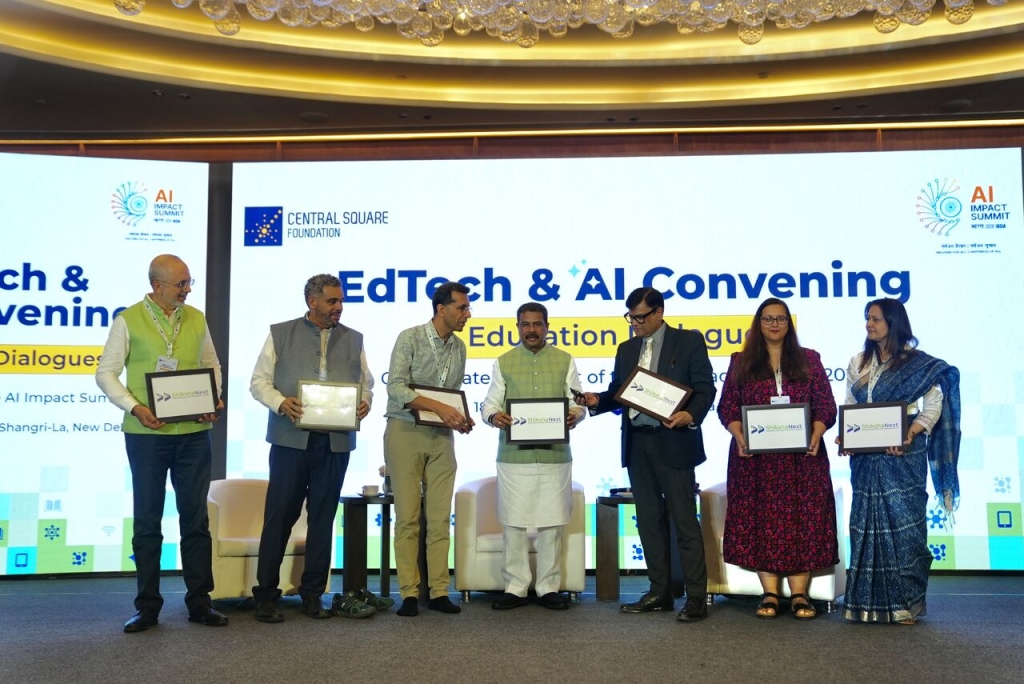
ShikshaNext is a three-year, ₹170 crore initiative with an ambition to support learning for more than 13 million children through meaningful EdTech and AI. Anchored by the Michael & Susan Dell Foundation, Reliance Foundation, and the Gates Foundation as Founding Strategic Partners, with Central Square Foundation as Managing Partner, ShikshaNext combines catalytic philanthropy and deep expertise to create a shared focus on execution and impact. Concurrent with the ambition for scale is a broader goal to bring together demand, supply and evidence so that the EdTech ecosystem can work more effectively.
The goal is to create a connected pathway; understand the problems that matter in education, encourage and strengthen solutions that can address them, test what actually works, and create the conditions for institutionalising the strongest solutions within government systems.
Three Pillars, one ecosystem
ShikshaNext is designed to support this pathway through three pillars, each addressing a different need in the EdTech ecosystem.
EdTech ScaleX is about making the most of what we already know. It works with evidence-backed EdTech and AI solutions across primary and middle school, helping governments move from proven solutions to effective, large-scale implementation. This includes building the partnerships, capabilities and systems needed to integrate technology into government education systems and reach millions of children. Evidence of impact is an important starting point. The next challenge is making a solution work within the realities of a large public education system, across different contexts and at scale. ScaleX is designed to help governments and solutions navigate that journey.
The EdTech Accelerator addresses a different need: strengthening the supply of good solutions. India will continue to face longstanding challenges in education, and we need a stronger pipeline of solutions that can respond to them. The Accelerator will support solutions serving children in primary grades, with an emphasis on building solutions that are pedagogically strong and relevant to India’s diverse needs. Some will go on to become solutions that can be taken much further; others may help us learn what does not work. Both are useful outcomes for an ecosystem that is still developing.
The EdTech and AI Innovation Hub looks further ahead. There are problems in education for which we do not yet have good enough solutions, and new technologies are creating possibilities that did not even exist a few years ago. The Hub creates space to find promising ideas, test new approaches and incentivise experimentation around problems where the potential impact could be significant.
Together, these three pillars allow ShikshaNext to work across the ecosystem; from ideas that are still being explored, to those that need strengthening, to solutions that are ready for much wider adoption.
Running across all three is a critical layer – evidence generation. ShikshaNext is investing in the evidence that can help the wider EdTech ecosystem make better decisions. This means building evidence at different stages – from establishing whether a product works, to understanding how it works when implemented within the constraints of a government system, to generating evidence on what it takes to implement it effectively at scale.
A mature EdTech ecosystem needs more than strong organisations. It needs shared information and common standards that allow different actors to make better decisions. This is why initiatives such as the Bharat Survey for EdTech (BaSE) – a first-of-its-kind, large-scale national survey that provides insights into access to and use of technology and AI for teaching and learning among parents, children and teachers from low-income backgrounds in India and EdTech Tulna – a research-backed EdTech and AI Evaluation Index at IIT Madras, designed to foster evidence-based, quality-led adoption of educational technology and AI in India and globally supporting the state governments to enable the adoption of high-impact EdTech and AI.
AI opens a new frontier
AI is changing the EdTech opportunity in fundamental ways. Some of the most interesting possibilities are AI-first solutions- products that could not have been built in the same way before the emergence of generative AI. An AI tutor that can respond dynamically to a child’s questions, tools that can support a teacher with mentoring, or systems that can generate and adapt learning material across languages are examples of capabilities that are now becoming possible.
At the same time, AI can make existing EdTech solutions around Assessment, personalisation, and content creation considerably more powerful.
This creates a significant opportunity for Indian EdTech companies, but we also need to be thoughtful about what good AI-enabled education should look like. Standards will matter, not just for whether a product works technically, but for whether it supports learning, is safe and reliable, and is appropriate for children and schools. Children and teachers will increasingly interact with AI, whether or not they are using an education-specific AI product. Understanding what AI can and cannot do, how to question its outputs, how to use it responsibly and how to recognise its limitations will become an important part of being able to learn and work with technology.
The opportunity is not simply to bring more AI into EdTech, but to use it thoughtfully, set clear standards for its use, and ensure that teachers and children have the understanding they need to use it well.
Building the connections
The strength of ShikshaNext ultimately lies in the connections between its different parts.
The government brings a deep understanding of the problems and the systems that have to deliver at scale. Innovators bring ideas and the ability to build. Researchers bring rigour and evidence. Implementation partners understand what happens when a solution moves from a product to actual practice. Philanthropy can provide the patient capital required to bring these pieces together.
When these groups work separately, good ideas can fall through the gaps between them. When they work together, each can make the others better.
At the centre of all of this, is a child – curious & eager to ask questions, and learn. The challenge is to build an ecosystem that is as responsive to that curiosity as it is to the complexity of the systems around it.
That is the opportunity ShikshaNext is trying to create.
The decision by three leading philanthropies to forge a shared, multi-year bet is significant not simply because of the scale of the investment, but because it creates the opportunity to work across the full journey of an EdTech solution.
The ambition is to help build an ecosystem where better ideas can emerge, stronger solutions can grow, evidence can inform decisions, and EdTech and AI can ultimately work better for India’s education system and most importantly, for the millions of children who are at the heart of why that system exists.


